← All guides·Guide 11 of 11
AI changes how long some tasks take. It does not change the rules that the fee must be reasonable and the record of it true, or the rule that the person whose name is on the document answers for all of it. This guide applies those rules to the two situations where they are most often tested: the fee note, and work done by a junior, a pupil or a devil.
Part A — Recording AI-assisted time
What counts as your time. The time spent instructing the tool. The time spent reading what comes back. The time spent checking it against the sources, which is usually the largest figure. Revising. Deciding what to use and what to discard.
What does not. The time the job would have taken without AI. The minutes the tool was running while you did something else. The afternoon spent learning a new tool, unless the attorney has agreed to pay for it.
A made-up example. Claude builds a first chronology from 400 pages of correspondence. It runs for ten minutes. You then spend two hours checking the entries against the documents and correcting them, and half an hour revising. Before AI, the same chronology might have taken a day.
On a time-based fee, the record is two and a half hours, not a day. The narrative says “Chronology of correspondence (AI-assisted first draft; checked against source documents and revised)”, not “prepared chronology from 400 pages”. On a fixed or daily fee, the fee is measured against all the factors in paragraph 29.2 of the Code, not only time, and using AI does not turn an agreed fixed fee into an hourly one.
Talk to the attorney first. If tool costs are to be charged, agree it before the work starts. If AI is going to change the cost of the work materially, raise it when the brief is accepted. Neither conversation is difficult. The difficult one is the one that happens afterwards.
Part B — Supervising a junior’s AI work
Two South African judgments make the point. In Northbound, senior counsel relied on an experienced team and did only a “sense-check” of the heads before they were filed (at [91]). The heads contained incorrect citations, and the conduct of the legal practitioners was referred to the Legal Practice Council (at [96]). In Mavundla, the research came from a candidate attorney, and the court found that the person responsible for supervising that research had not done “the most basic check” (at [54]).
A sense-check is not a check.
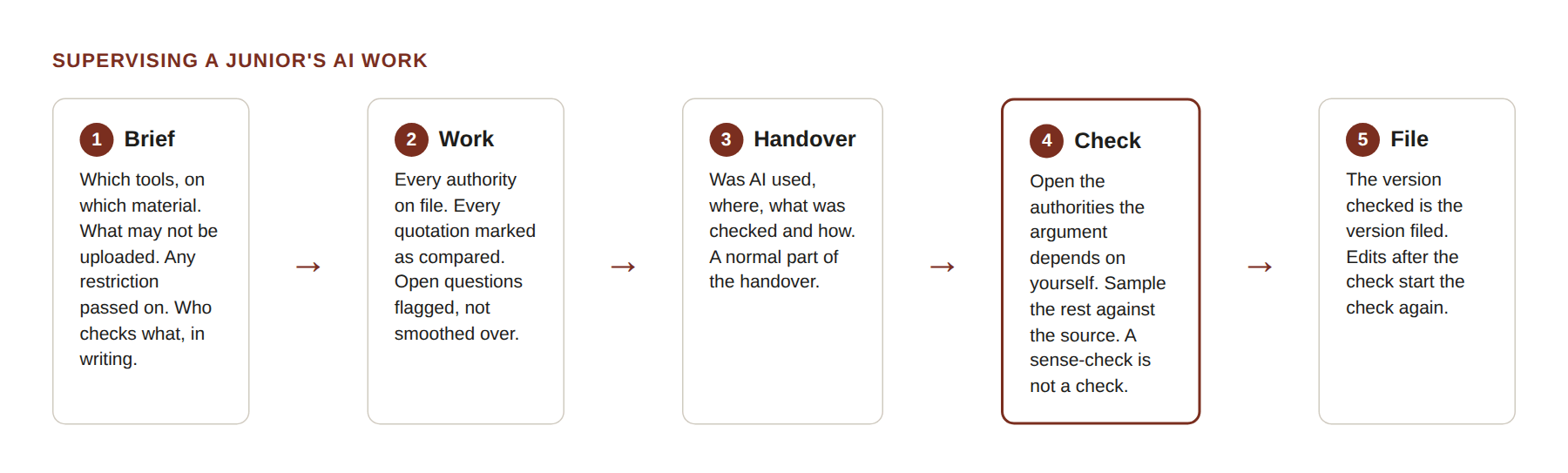
When you brief. Say which tools may be used and on which material. Say what may not be uploaded. Pass on any restriction from the attorney or the client. Ask to be told when and how AI was used, as a normal part of the handover rather than an accusation. If more than one person is working, agree in writing who checks what. A short note does it. A made-up example:
Research on prescription for the heads. You may use Claude on the public judgments and on the pleadings. Do not upload the client's emails. Download every judgment you cite into research/. Mark each quotation as checked against the judgment, with the paragraph number. Tell me which parts AI helped with.
While they work. Ask for work that shows its checking: each authority on file; each quotation marked as compared; open questions flagged rather than smoothed over. A junior who says “I could not find this in the judgment” is doing the job. A junior who quietly adjusts the quotation so that it reads better is doing the thing that ends in a costs order.
When it comes back. Ask: was AI used, where, and what was checked and how. Open yourself the authorities the argument actually depends on, all of them. Sample the rest: a few quotations chosen at random, against the source. Use the junior’s record of what was checked to decide where to look; do not use it instead of looking.
Before it is filed. Check the version that is filed. Edits after the junior’s checks, including your own, introduce new errors. The checks are of the final version, and the record says so.
Training independent analysis
Preserve opportunities for juniors to analyse a problem before seeing an AI answer. For a training exercise, choose a public or made-up problem. Ask the junior to identify the issues, read the primary authorities and write a short independent analysis. Then compare it with an AI-generated answer: identify unsupported propositions, omissions and weaknesses, and check both versions against the sources. Discuss what changed and why. This exercise develops judgment; the final work still needs the checks described above.
Menon CJ suggests this approach in paragraph 19 of A Profession in Transition (16 September 2026). The Research entry links to the official speech and explains its status as Singapore policy commentary.
For heads of chambers and group leaders
In Ayinde, the Divisional Court in England said that those with leadership responsibilities, heads of chambers among them, must take practical and effective measures so that everyone understands their duties when using AI (at [9]). It is English law, not ours, but the idea is plainly right for a group or chambers here: some training for pupils, a simple house rule on AI use, and a named person to ask.
Check yourself
At the end of this guide your fee notes should record the time actually worked and describe AI-assisted work truthfully; any tool cost or material change in the cost of the work should have been agreed with the attorney in advance; every junior working with AI on your matters should have a written note of what may be used on what, and should be handing over work that shows its checking; and the version filed should be the version checked.
Sources on file: LPC Code of Conduct, paras 28.4, 29.1, 29.2, 29.3, 34.5 and 34.6. GCB Uniform Rules of Professional Ethics, rules 4.26 and 7.1.1. Northbound Processing (Pty) Ltd v South African Diamond and Precious Metals Regulator [2025] ZAGPJHC 661, paras [91] and [96]. Mavundla v MEC: Department of Co-Operative Government and Traditional Affairs KwaZulu-Natal [2025] ZAKZPHC 2; 2025 (3) SA 534 (KZP), para [54]. R (Ayinde) v London Borough of Haringey [2025] EWHC 1383 (Admin), para [9].