31 October 2026 · New York bar: bill the time spent, not the time AI saved
The New York State Bar Association’s House of Delegates adopted its Legal Ethics Guidelines for Lawyers’ Use of Artificial Intelligence on 31 October 2026. The 96-page report explains how the New York Rules of Professional Conduct apply to AI. It does not amend those rules or create separate disciplinary obligations.
Guideline 5A deals with fees. A lawyer who bills by the hour may charge only for time actually spent, including time spent preparing inputs and reviewing, verifying and revising the output. The lawyer may not bill for the time the work would have taken without AI, or for the value of the work rather than the time spent.
Time spent gaining general familiarity with a tool may not be billed. Time reasonably spent adapting or applying it to the particular matter may be. The general cost of acquiring and maintaining a tool is ordinarily overhead. It may be charged as a disbursement only if it was incurred for, or is reasonably allocable to, the client’s matter, the basis of the charge is disclosed and the amount is reasonable.
Non-hourly fees are treated differently. Efficiency gains alone do not require a lower flat or contingent fee, but the fee must still not be excessive under the usual factors.
The report goes well beyond fees. Guideline 9E says reasonable supervision of an AI system that can act includes a lawyer’s approval before it takes a consequential or not readily reversible step, such as filing a document, sending substantive information to a client or court, or transferring funds.
This is New York professional guidance and does not bind lawyers elsewhere. The Law Society of England and Wales’ note of 21 October takes a similar line on time-based bills, and Guide 11 takes the same approach to recording AI-assisted time.
Sources: New York State Bar Association: Legal Ethics Guidelines for Lawyers’ Use of Artificial Intelligence (PDF) · New York State Bar Association release, 31 October 2026
28 October 2026 · UK tracker of AI hallucination cases reaches 100 entries
This is a commentary and tracker update by an English barrister, not a judgment or official guidance. Matthew Lee reports that his collection of UK decisions involving suspected, confirmed or disputed AI errors and false citations now has 100 entries, after adding thirteen decisions. They come from employment tribunals, the Family Court, the County Court, the High Court, the Upper Tribunal, the Sheriff Appeal Court and the Scottish tax tribunal.
On his provisional classification, the Employment Tribunal accounts for 24% of entries, the First-tier Tribunal 21%, the High Court 17% and the Upper Tribunal 16%. He places 64% in a litigant-in-person category, which includes lawyers acting for themselves and unrepresented companies. Lawyers or law-firm teams make up 18%, and 18% are other, mixed or unclear.
He cautions that the figures describe his collection only. They count entries, not unique judgments, and they do not show how often AI is misused. An entry does not establish that anyone used AI or acted dishonestly. He also raises the cost of checking an opponent’s AI-generated authorities, and the difficulty of detecting hallucinations in evidence and expert material.
These are English and Scottish decisions. They do not bind South African courts. I have not read the underlying judgments.
Sources: Matthew Lee, 100 UK AI Hallucination Cases/False Citations (Confirmed or Suspected), Natural and Artificial Law, published 28 October 2026, updated 29 October 2026 (accessed 5 November 2026).
22 October 2026 · Fifth Circuit orders reassignment after AI-tainted court orders
The US Court of Appeals for the Fifth Circuit has vacated a preliminary injunction and directed that Jackson Federation of Teachers v Fitch be assigned to a different district judge for further proceedings.
The appeal concerned Mississippi’s restrictions on diversity, equity and inclusion programmes in public education. The opinion records invented parties and declarations in an earlier temporary restraining order, along with false quotations from the statute. A replacement order still cited a case that did not exist. The preliminary injunction incorporated the earlier reasoning.
The court also found legal errors. Reassignment followed its supervisory tests for fairness and the appearance of justice. Haynes J agreed only with the final paragraph ordering vacatur, remand and reassignment.
The judge was removed from this case; this was not removal from judicial office.
Sources: Jackson Federation of Teachers v Fitch, No. 25-60496 (Fifth Circuit)
21 October 2026 · UK Law Society publishes a practical AI note
The Law Society of England and Wales’ practice note explains how existing professional duties apply to AI. Its practical guidance covers the following areas.
Check the work
Verify facts, authorities and reasoning against primary sources. Look for omissions and automation bias. Responsibility remains with the solicitor.
Protect client information
Check retention, training use, access and provider terms. A paid subscription alone does not establish adequate safeguards.
Inform clients
Explain relevant AI use and risks. Consent depends on the circumstances; exposing confidential information, including for training, may require specific consent.
Make supervision practical
Define permitted uses, reviewers, checks and escalation routes. Give supervisors training and time. Preserve juniors’ opportunities to develop research and drafting skills.
Control agents
Limit permissions and data access. Set human approval points before actions affecting clients or legal obligations.
Charge for work performed
Time-based bills should reflect actual work, including appropriate verification, rather than hypothetical time saved. Explain and agree separate technology charges without double recovery.
The note states the Society’s view of good practice. It is professional guidance, not legal advice.
Sources: Law Society of England and Wales: Using artificial intelligence in legal practice
Australia’s Fair Work Commission offers prompts to reduce AI mistakes
Australia’s Fair Work Commission has published set-up prompts for more accurate, balanced AI assistance. The adaptation below removes its jurisdiction-specific instructions.
Adapted set-up prompts
Apply these instructions throughout our conversation:
1. Use authoritative sources relevant to the jurisdiction and issue.
2. Put accuracy and impartial analysis ahead of agreeing with me.
3. Never fabricate facts or authorities. Explain conflicts between sources.
4. Treat my account as unverified. Identify inferences separately.
5. Assess my position independently of how confidently I describe it.
6. Identify missing information and explain why it matters.
7. Ask for clarification instead of filling gaps with assumptions.
8. Separate factual accounts, legal sources, procedure and your assessment.
9. Explain uncertainty and its effect on your answer.
10. Identify each authority and provide a way to verify it.
11. Write plainly. Avoid flattery, emotional reassurance and combative language.
12. Check jurisdiction and eligibility before assessing a proposed claim.
13. Explain when evidence or law undermines my position.
14. Avoid certain predictions; explain strengths, weaknesses and limitations.
These prompts guide the tool; they do not verify its answers. Read the sources and check the result yourself.
Sources: Fair Work Commission: Using AI to help you with your case
13 October 2026 · Texas Supreme Court considers AI-generated deposition transcripts
The Texas Supreme Court has heard argument in a case that could clarify whether an AI-produced deposition transcript may be used in litigation when the deposition was recorded on video but no certified shorthand reporter prepared the written transcript.
In re Patrick Hughey, No. 25-0463, began as part of a wrongful-termination claim. Hughey arranged for a deposition of his former employer’s corporate representative using Skribe.ai. The software produced a transcript from the video recording. The trial court later struck the transcript and barred future depositions conducted in the same way.
The Texas Ninth Court of Appeals denied Hughey’s request for relief. It reasoned that the video itself had not been excluded and remained available; a certified reporter could prepare a transcript if one was needed.
The issue is transcription, not AI-drafted legal argument
That distinction matters. This case is about using AI-assisted speech-to-text to produce a written record of testimony. It is not about AI generating legal submissions, authorities or judicial reasoning.
At the Supreme Court’s oral argument on 6 October 2026, several justices questioned whether accuracy concerns could be addressed by checking the transcript against the video, or by ordering a certified transcript where necessary. The opposing argument focused on the rules governing deposition transcripts, reliability and the status of an uncertified transcript.
The procedural question is narrow but consequential: can a transcript produced this way be used, and what safeguards should apply when the recording is available to check it? The justices’ questions at argument are not a decision. As of 13 October 2026, I found no ruling in the case.
Sources
10 October 2026 · Judges and lawyers are teaching themselves AI
The African Court on Human and Peoples’ Rights has held a four-day seminar on artificial intelligence and the rule of law with UNESCO. It took place at the Court’s seat in Arusha, Tanzania, during the Court’s 82nd Ordinary Session (31 August to 25 September 2026). More than 50 people attended. They included judges, legal officers, and staff from the language, documentation, library, communication and IT units.
The training used UNESCO’s Global Toolkit on AI and the Rule of Law for the Justice Sector. The aim was to help the Court use AI responsibly: to work faster and widen access to justice, while guarding against bias, discrimination, opacity and threats to fundamental rights.
The Court’s President, Justice Blaise Tchikaya, said the Court cannot stand aside while AI changes how justice is administered. He also warned that technology is not neutral. Responsibility stays with the people who use it.
The Registrar, Dr Robert Eno, made the same point. He said AI must be “a servant of justice, never its substitute.”
UNESCO’s Regional Adviser, Misako Ito, cited a UNESCO survey (2023–24, 96 countries). It found that 44% of judicial operators already use AI tools such as ChatGPT in their work. Only 9% said their organisations had issued guidance or provided training.
Most lawyers and judges who use AI are teaching themselves. That is risky. They need training, clear rules on checking AI output, and to accept that the final work product is their responsibility, not the tool’s. This site exists to help with that.
Source: Francis Ameyibor, “African Court embraces the AI revolution, partners UNESCO to shape justice in Africa“, ModernGhana, 10 October 2026. Based on a statement issued by the Court.
9 October 2026 · US court awards fees following fabricated AI citations
In Flycatcher Corp v Ozmos Company, a New York federal court ordered Steven Feldman to pay Joel MacMull and his firm US$38,877.59 in fees and research costs following earlier sanctions for false AI-generated citations and dishonesty.
MacMull had investigated and reported the misconduct while representing another defendant in the litigation. The court accepted that this work assisted it. Its award also covered substantial work on the later fee application; it was not simply payment for finding fake cases.
The court reduced the US$42,090 fee component by 10% and allowed US$996.59 in research costs. It assessed reasonableness using supported time records.
Sources: Flycatcher Corp Ltd v Ozmos Company LLC, fee order (SDNY, Dkt 364) · Noland v Land of the Free LP, B331918 (California Court of Appeal)
9 October 2026 · Correcting an AI error: candour and remedial action
In Glenn v Absolute Resolutions Investments, a Florida federal court took no further action after counsel corrected AI-related citation errors and undertook remedial measures. The order records apologies to the client, opposing counsel and the court, a donation of the fee to legal aid, further education and changes to office procedures.
The court found those steps sufficient in the circumstances. It did not promise that an apology or donation would prevent sanctions in another case.
The contrast with Lnu v Blanche is instructive. In June, the Ninth Circuit imposed monetary sanctions and six-month suspensions after inaccurate filings and repeated failures of candour. In Matter of Sethi, first issued on 15 September and designated as precedent on 1 October, the Board of Immigration Appeals imposed reciprocal suspension before the Board, immigration courts and DHS, effective from 13 June.
These decisions show why the response to an error deserves attention alongside the error itself. A suggested working approach is to identify the defect, preserve the source material and address correction promptly through the applicable procedure.
Sources: Glenn v Absolute Resolutions Investments LLC (M.D. Fla., Dkt 74) · Lnu v Blanche, No. 24-4790 (Ninth Circuit) · Matter of Sethi, 30 I&N Dec 112 (BIA)
8 October 2026 · When should AI make a decision, and when should a person stay in charge?
What decisions should AI be trusted to make, and when should a person remain in charge? A framework from MIT’s Center for Information Systems Research (MIT CISR) offers a practical way to think about that question.

The matrix uses two dimensions: ambiguity—how clearly the available information points to an answer—and risk—the consequences if the decision is wrong. It sorts decisions into four broad types:
- Routine: low ambiguity and low risk. Defined steps may be automated, with a human process owner monitoring results.
- Consequential: low ambiguity but high risk. Set guardrails; have people monitor execution and handle exceptions.
- Exploratory: high ambiguity but low risk. Use AI to explore possibilities while people guide the work and review outcomes.
- Strategic: high ambiguity and high risk. People lead the framing and learning; AI supports analysis and action.
The framework also breaks decision-making into three stages: frame the problem, act, and learn from the outcome. The same AI capability may be appropriate in one context and risky in another. Oversight should therefore depend on the decision being shaped, not simply on the tool being used.
What might this mean for lawyers?
Applied to legal practice, the matrix suggests asking about the decision a task supports—not just whether the task is labelled “AI-assisted”. AI might help organise documents or generate research leads. But those outputs can feed into advice, evidence, pleadings or submissions, where the consequences of error may be serious.
A lawyer still needs to define the question, check the material, decide what to rely on and remain accountable for the work. That is an application of the framework to legal practice; it is not a legal rule stated by MIT.
The authors say the framework draws on 30 interviews with 27 executives at nine global companies, including organisations in the legal sector. It is a management framework informed by interviews, not a validated legal risk test or a prescription of professional duties. Its value is as a prompt for careful questions: What decision is this tool helping to shape? What happens if it is wrong? Who checks the result, and who remains accountable?
Sources:
MIT CISR, “Designing Decision Rights for AI”
MIT Sloan, “A framework for determining when AI can make decisions”
2 October 2026 · Lord Sales: AI and judicial responsibility
In Artificial Intelligence, Constitutional Courts and Judicial Responsibility, Lord Sales, Deputy President of the UK Supreme Court, considers how constitutional courts should use AI. The speech was prepared for a conference organised by the Constitutional Court of Montenegro in Tivat. It identifies useful roles for AI in research, document organisation, public explanations and administration, alongside risks of unreliable outputs, opaque processes, loss of confidentiality and dependence that weakens critical reasoning.
His central point is that constitutional adjudication requires independent human judgment and public accountability. AI can assist the work, but cannot bear constitutional responsibility: “Technology may assist that process. It cannot replace it.” For practitioners, the speech reinforces the need to verify AI outputs and retain responsibility for the reasoning. This is a judicial speech, rather than a judgment or binding practice direction.
Read Lord Sales’s full speech (PDF, UK Supreme Court). The text dates the presentation 2 October 2026; the filename refers to 1 October.
1 October 2026 · When an expert’s ChatGPT history becomes evidence
Eugene Volokh, a law professor emeritus at UCLA and senior fellow at Stanford’s Hoover Institution, discusses an interesting decision on The Volokh Conspiracy: which parts of an expert’s ChatGPT history must be disclosed to the opposing party?
In Villanueva v Las Vegas Metropolitan Police Department, an expert used ChatGPT to research and prepare his report. The defendants sought his conversation history. The court drew a distinction between material informing his opinion and material revealing his preparation and thought process.
The AI-generated case summaries had to be disclosed because the expert had considered them. Whether he ultimately relied on them was not decisive. Those responses also allowed the opposing party to examine allegedly invented citations, quotations and legal propositions.
The court protected other parts of the history, including prompts, deposition-preparation material and report drafts. It also rejected the argument that using ChatGPT in this way had waived the relevant protections.
The decision raises a practical question for anyone working with expert evidence: what has AI contributed to the opinion, and what record exists of that contribution? The finished report may reveal only part of the research behind it.
30 September 2026 · California signs law on AI use by lawyers and arbitrators
Governor Gavin Newsom signed Senator Thomas Umberg’s SB 574 on 30 September. The official legislative history records approval, corroborated by the Governor’s announcement. It is enacted California legislation, with ordinary commencement on 1 January 2027 under Government Code section 9600. It is not already operative on the date of this entry.
- Lawyers: no delegation of legal practice to generative AI; restricted access and confidentiality protections for nonpublic inputs; reasonable steps to verify outputs and correct errors; and disclosure of AI use to the court for all submitted documents (new Business and Professions Code section 6068.1).
- Citations: the submitting attorney must personally verify every citation in filed papers, including AI-supplied citations (Code of Civil Procedure section 128.7(b)(2)(A)).
- Arbitrators: no delegation of any part of decision-making to generative AI. AI-generated information outside the record requires prior disclosure and, as far as practical, an opportunity for parties to comment (new section 1282.1).
- Judges: the Judicial Council must publicly revisit and, where necessary, revise Standard 10.80 as AI develops (new section 180). This provision does not impose the lawyer’s disclosure requirement on judges.
The distinction between assistance and delegation deserves attention in South African practice, particularly when supervising research or conducting arbitration. The California disclosure rule does not create a South African duty. For practical checks, see Own the work, Guide 9 and Guide 11.
Status checked 1 October 2026. The Legislature’s text page still displays the enrolled version dated 4 September; its history records the subsequent approval. Existing California judicial AI guidance is collected in For judges.
17 September 2026 · US federal judiciary reports interim AI guidance
The official US Courts release reports interim guidance cautioning courts against delegating core judicial functions, including decision-making and adjudication, to AI. Judiciary users remain accountable for AI-assisted work. The full guidance is not reproduced in the release. This is foreign institutional material, included for comparison; see For judges.
16 September 2026 · Florida appeal court: real citations, unsound reasoning
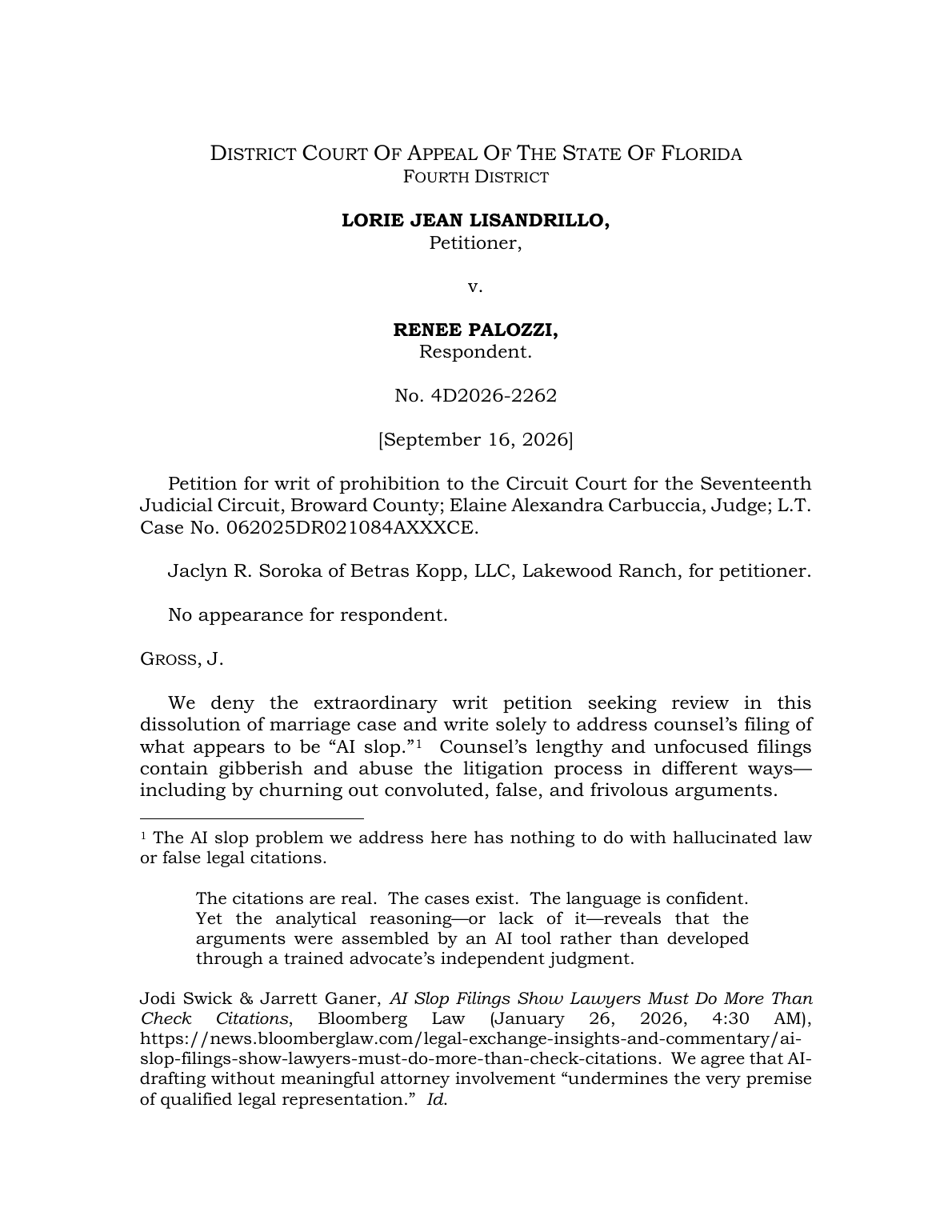
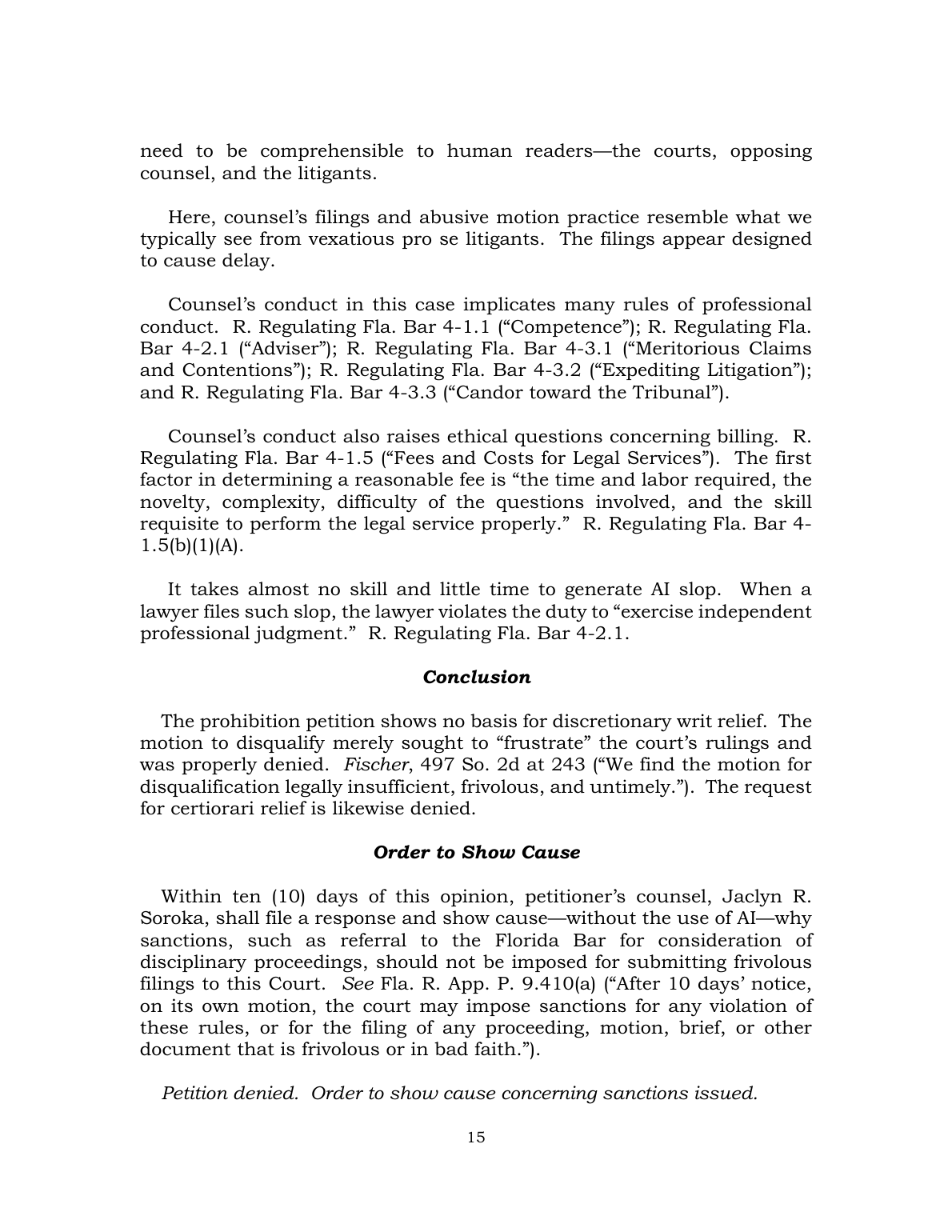
In Lisandrillo v Palozzi (No. 4D2026-2262), Florida’s Fourth District Court of Appeal denied a petition and criticised counsel’s lengthy, unfocused filings, arguments contrary to the record, and frivolous motion practice. Its opening footnote says the concern was not hallucinated law or false citations: the cases and citations were real. The court suspected AI-generated components, but did not establish that AI was used. It ordered counsel to respond within ten days, without using AI, and explain why sanctions, including a possible referral to the Florida Bar, should not follow. That is an order to show cause, not a sanction already imposed.
The point for advocates is wider than citation checking: read the authorities, test each proposition against them and the record, decide which arguments belong, and make the submission comprehensible to its reader. This is a US judgment, persuasive at most in South Africa. It sits alongside Own the work, Be concise and Guide 9. SMB Attorney’s post drew attention to the decision; the linked court opinion is the source.
29 September 2026 · A judge asks how junior lawyers will learn to draft
In Hill v Foundation Media, United States District Judge Arun Subramanian took no further action over counsel’s AI use, while warning about verification and the training of junior lawyers.
The order calls for checking every citation, quotation and legal proposition in an AI-assisted brief. On the training of junior lawyers, the judge said:
And finally, over-reliance on AI risks stunting the training of young lawyers. The use of AI may be unavoidable, but mentoring young lawyers is a joint responsibility that we all share. Practitioners should think about ways to ensure that junior lawyers are getting the training they need, even as reliance on these technological tools increases. (One example might be making sure that, at the very least, the initial drafting of briefs is done without the assistance of AI.)
— Hill v Foundation Media LLC, order of 29 September 2026, p 1.
The suggestion is a training option, rather than a general prohibition. It gives supervisors a concrete question to consider when allocating work: which parts of a task should the junior undertake personally to develop the skill needed to review it later?
This is a US district-court order dated 29 September. The Reuters report followed on 2 October.
Sources: Hill v Foundation Media LLC (SDNY, Dkt 57)
21 September 2026 · Irish Circuit Court separates AI use in evidence and submissions
Ireland’s Circuit Court Practice Direction CC34 took effect on 21 September 2026. It covers civil and criminal proceedings, including unrepresented parties.
Witness evidence
AI may assist with formatting or spelling, but should not create, strengthen or rephrase substantive evidence. Unless the court directs otherwise, an opening declaration must confirm this and identify the evidence as the witness’s own.
Legal submissions
AI assistance should be acknowledged. The submission should confirm that its content has been checked, its sources exist and it accurately represents them.
Expert reports
The report must contain an opening declaration that its substance is the expert’s own, except where expressly stated otherwise. Any AI contribution must be disclosed sufficiently to assess reliability, independence and weight.
Confidential material
AI use must respect court orders and undertakings restricting disclosure, including restrictions applying to private proceedings.
Responding to a breach
A party identifying apparent misuse of AI should notify the party concerned and request immediate correction. If the problem is not satisfactorily resolved within one working day of notification, the notifying party should immediately inform the court. The court then decides whether the direction was breached.
Consequences
Possible sanctions include costs orders, rejection of documents and striking out claims or defences. Practitioners also risk personal costs or disciplinary referral.
3 September 2026 · D.C. Court of Appeals strikes brief containing four nonexistent authorities
In Douglas v Deutsche Bank National Trust Co., the District of Columbia Court of Appeals struck Deutsche Bank’s appellate brief after counsel confirmed that four cited authorities did not exist. Counsel said she had used Google’s generative-AI search tool to locate cases but had not checked that the citations were genuine. The court also referred the matter to the Office of Disciplinary Counsel for any investigation it considers appropriate. Read the published order.
The majority treated the fabricated citations as a serious failure of counsel’s duty to verify legal authorities, whether or not AI was involved. It said its aim was not to discourage lawyers from using AI, but to insist on discerning and responsible use.
Senior Judge Stephen Glickman agreed with the order and wrote separately. He called fake citations “only the tip of a perilous iceberg,” arguing that AI-generated inaccuracies in real legal authorities may be harder to spot, and that relying on AI to do the legal thinking involved in drafting a brief raises a broader concern. He also cautioned that the court did not know whether counsel had used AI to draft this brief. On the record before him, he said a finding of bad faith or recklessness was not established.
The case therefore highlights two distinct issues: lawyers’ responsibility to verify every authority they file, and the more difficult question raised in the concurrence about how far AI should be relied on for substantive legal reasoning. Read Judge Glickman’s concurrence.
Case: Douglas v Deutsche Bank National Trust Co., No. 24-CV-1099 (D.C. Ct. App., 3 September 2026).
1 September 2026 · Irish courts introduce directions on AI in court documents
Ireland’s High Court Practice Direction HC142 and Court of Appeal Practice Direction CA16 became operative on 1 September. They address responsible use of generative AI in court documents, independent verification and safeguards for witness and expert evidence. These are Irish procedural directions, relevant comparatively to South African practitioners. The sources are also listed on Research.
31 August 2026 · Quebec’s four courts tell their judges what AI may and may not do
The Court of Appeal, the Superior Court, the Court of Québec and the municipal courts issued joint guidelines on the use of generative AI by judges, signed by their four chief judges and dated 31 August 2026. The ten-page French original is on file; an unofficial English translation is available here. The preamble ends with the sentence the whole document turns on: “Juger est un acte exclusivement humain.” Judging is an exclusively human act.
What a judge should not use it for (section 4): legal reasoning, the analysis and characterisation of facts, assessing evidence and credibility, deciding the outcome, and drafting any part of the reasons. What may be considered, under strict conditions (section 5): purely linguistic correction or translation of text the judge has already written (not draft judgments), routine administrative tasks, a factual chronology from material the judge has already identified, a strictly descriptive summary of a witness or document with no assessment in it, and finding things in a closed set of documents supplied to the tool, “sous réserve d’une vérification systématique à la source”. Conditions (5.3): full and continuous human control, independent verification of everything generated, no confidential or identifiable data, an understanding of the tool’s limits, and the ability to explain and own the result. In case of doubt, abstain.
Two points worth carrying over to practitioners. Section 6 says a judge must check that the tool’s settings do not allow the data entered to be used for training, and must not feed documents from parties into a tool as they are, because they may contain hidden instructions that steer the tool. That second warning appears to be the first time a court has named what the technical literature calls prompt injection. And the whole of section 5 is a fair description of the source-pack method in Guide 8: closed sources, descriptive tasks, verification at source, the judgment left to the human.
Foreign, for judges, and persuasive at most. But it is the most careful statement by any bench on file of where the line runs, and Annex A is a one-page self-assessment grid a practitioner could adapt tomorrow.
24 August 2026 · Australian tribunals set expectations for generative AI
The Administrative Review Tribunal announced its Generative AI Practice Direction, signed on 20 August, setting expectations for responsible use and identifying circumstances requiring caution, verification, explanation or disclosure.
The Fair Work Commission also released guidance on GenAI in Commission cases. It requires disclosure of when and how GenAI was used, personal checking of accuracy and relevance, and witness evidence based on the witness’s own knowledge and words. The guidance took effect on 20 October 2026. These are Australian tribunal materials; see Research.
31 July 2026 · Johannesburg full bench: the fake case was in the judgment
FJL v TGO (2025/220239, GJ). The acting judge’s judgment under appeal cited a case that does not exist and mis-cited several real ones; the full bench put them aside, decided the appeal on the law as it is, and referred the judgment to the Legal Practice Council. Opperman J: “Names of non-existent cases are not law.” No finding was made that AI was used. A write-up is on the blog, and the case is the reason Guide 9 has seven checks and not one.
July 2026 · Revised proposed guidelines for South African practitioners
Thaldar, Mbatha, Botes and Esselaar published their revised guidelines on responsible AI use in De Rebus after a year of consultation. An academic proposal, adopted by no regulator yet. The most developed South African text so far, and one of the texts the proposed guidelines for advocates on this site are written against.
October 2025 · England and Wales judiciary updates its AI guidance
The judicial guidance puts the integrity of the administration of justice and the rule of law at the centre. Not South African law, but a clear statement, from a bench, that the person whose name is on the work answers for it.
2025 · Supreme Court of Pakistan writes the judgment on judges and AI
Ishfaq Ahmed v Mushtaq Ahmed, CPLA 1010-L/2022 (Syed Mansoor Ali Shah and Aqeel Ahmed Abbasi JJ, heard 13 March 2025). A rent dispute between brothers, which the court used to write at length about AI in an overburdened judiciary. Its conclusion at para 17: AI “must be welcomed with careful optimism” but “cannot replicate the moral, ethical, and empathic reasoning that lies at the heart of judging”. It recommended national guidelines on permissible judicial use (para 18). Foreign and persuasive at most, but the most thorough judicial treatment on file, and worth setting beside FJL v TGO.
January 2025 · Mavundla: the leading South African judgment so far
Mavundla v MEC: Department of Co-Operative Government and Traditional Affairs KwaZulu-Natal (PDF) [2025] ZAKZPHC 2. Non-existent authorities in heads, research done by a candidate attorney, and a supervising practitioner who had not done “the most basic check” (at [54]). Read the judgment, not the reports of it. It is the starting point for Guide 11 on supervision.
July 2024 · ABA Formal Opinion 512
The American Bar Association’s first ethics opinion on generative AI: competence, confidentiality, communication, candour, supervision and fees. American, and useful mainly as a list of the questions any bar has to answer.
29 June 2023 · Parker v Forsyth: the first South African one
Parker v Forsyth NNO and Others (1585/20) [2023] ZAGPRD 1, Regional Court, Johannesburg. In a defamation action against body corporate trustees, the plaintiff’s attorney sourced authorities through ChatGPT and handed them to the other side; the cases did not exist (paras 86–87). The court found no intention to mislead, only attorneys who “placed undue faith in the veracity of the legal research generated by artificial intelligence and lazily omitted to verify the research” (para 89), and gave the reminder that “the efficiency of modern technology still needs to be infused with a dose of good old-fashioned independent reading” (para 90). Costs of the wasted hearing; not punitive, “simply appropriate” (para 91). Two years before Mavundla, and already the whole lesson. On file.
Elsewhere, 2026, in one line each
Developments abroad this year, all on file. Ontario’s Rules of Civil Procedure r 4.06.1 now requires a certificate covering the accuracy of quotations, not only the existence of authorities (from 1 September 2026). The SRA published a warning notice on misuse of AI (17 August 2026). The Supreme Court of India published draft regulations for AI in courts (3 June 2026). Australia’s Federal Circuit and Family Court issued PD-AI (29 May 2026). The Bar Standards Board issued its guidance on AI (18 May 2026). Singapore’s Ministry of Law published its guide for the legal sector (6 March 2026). The international comparison page sets these against the eight guidelines.
How this page works
Every entry is dated and says what kind of thing it is: judgment, rule, professional guidance, research. Primary sources over commentary; a news report is a route to the judgment, not a substitute. Foreign material is marked as foreign and is persuasive at most. Anything about a product was true on the date of the entry and may not be by the time it is read. The full reading list is on the Research page.
6 March 2026 · Singapore High Court fines two lawyers over fabricated AI case citations
The General Division of the High Court of Singapore made personal costs orders against two lawyers after fictitious case citations turned up in closing submissions filed in a family trust dispute, Tan Hai Peng Micheal and another v Tan Cheong Joo and others. The judgment, by Justice S Mohan and reserved on 6 March 2026, dealt with costs across three related suits over the estate of the late Tan Thuan Teck.
The closing submissions, filed on 7 July 2025 by defence counsel, cited two authorities on which side carried the burden of proving the deceased was an “excluded moneylender”. Neither case could be found in Singapore’s legal databases. One combined a real case name with a citation number that belonged to a different case; the other did not exist at all. The initial draft had been prepared by a paralegal who had left the firm in early July 2025 and could not be reached; an assisting solicitor reviewed it before sending it to counsel, who filed it without checking the citations. The court found it “plainly evident” that a generative AI tool had most likely been used somewhere in that process, though neither lawyer could confirm this.
The court held that citing fictitious authorities was “sanctionable misconduct”, and that counsel on record carries a non-delegable duty to ensure submissions are accurate, whoever drafted them. It ordered the two lawyers to pay personal costs of S$5,000 each, S$10,000 in total, on an indemnity basis, as part of a global S$180,000 costs award across the three suits. Neither lawyer may bill the defendants for time spent on the issue, and counsel was ordered to confirm he had told his clients about the judgment. The court declined a request from the parties to deal with the matter privately, and said a further instance could lead to disciplinary proceedings.
A Singapore ruling does not bind South African courts, but its reasoning matches what South African courts have already said in similar cases: an unchecked citation, however it was produced, remains the responsibility of the lawyer who signs the document it appears in.
Sources: Tan Hai Peng Micheal and another v Tan Cheong Joo and others [2026] SGHC 49