← All guides·Guide 8 of 11
Non-existent cases do not come from nowhere. They come from a language model answering from what it absorbed in training, which includes a million citations and a good idea of what one looks like. The remedy is to give it the documents and tell it to use nothing else. This guide sets up the research folder and the source pack, and shows what to ask.
research/ subfolder. Access to SAFLII and to whatever law report service you subscribe to.The one rule
A case may be cited in any document produced in the matter only if the judgment itself is in research/, as a PDF you downloaded, with a note of where it came from. Not a list of case names. Not a headnote. Not Claude’s account of what the case held. The judgment.

This rule does more than any tool. It makes existence checking automatic, because a case with no file cannot be cited. It puts the full text where Claude can read it, so that quotations come from the judgment and not from memory. And it leaves a record: anyone opening the folder can see which authorities the matter rests on.
The South African judgments on the Research page show the cost of not having it: authorities sourced through a chatbot and handed over unread (Parker v Forsyth NNO and Others [2023] ZAGPRD 1); non-existent authorities in heads and a supervising practitioner who had not done “the most basic check” (Mavundla v MEC: Department of Co-Operative Government and Traditional Affairs KwaZulu-Natal [2025] ZAKZPHC 2 at [54]); errors traced to a subscription legal tool in heads that senior counsel had only sense-checked (Northbound Processing (Pty) Ltd v South African Diamond and Precious Metals Regulator [2025] ZAGPJHC 661 at [89] and [91]).
Step 1 — Find candidates, and treat them as leads
Claude can be asked what authorities exist on a point. Treat the answer as a list of leads, not as research. Every name on it has to be found in a law report or on SAFLII before it means anything, and a proportion will not be found, because they do not exist, or exist under a different name, or exist and say something else.
Most of the finding is done where it was always done: your subscription service, SAFLII, the textbooks. The difference now is what happens next.
Step 2 — Download the judgment into the research folder
For each authority you may rely on, download the judgment as a PDF into research/. SAFLII provides one for most judgments; the law report services provide the reported version. Name the file so that it can be found: party names and citation.
Then record it. Keep a plain-text file, research/_sources.md, with one line per document: the file name, where it came from (the address), the date you downloaded it, and whether you have confirmed it is the case you meant. A made-up example:
Mavundla v MEC COGTA KZN [2025] ZAKZPHC 2.pdf — SAFLII, https://www.saflii.org/za/cases/ZAKZPHC/2025/2.html — 12 September 2026 — confirmed: parties, court and date match
If Claude has internet access on your plan, you can give it the address and ask it to do the download and the note:
Download the judgment at [address] as a PDF into research/, named with the parties and citation. Add a line to research/_sources.md with the file name, the address, today's date, and the parties, court and date as they appear on the first page of the PDF. Do not cite or summarise the judgment; only fetch and record it.
Either way, open the PDF once yourself and confirm that the first page shows the case you wanted.
Step 3 — Confirm it is the case you think it is
Right name and wrong citation is the commonest error in citations, in AI-assisted drafts and in others. Ask, for the whole folder at once:
For every PDF in research/, read the first two pages and give me a table: file name; the parties as printed; the court; the date; the neutral citation or report reference as printed. Flag any file whose name does not match what is printed inside it.
Fix the file names and the source list from that table.
Step 4 — Build the source pack
A source pack is the set of documents Claude may use for one task, kept apart from everything else. Four parts, in four places, so that Claude and you can tell them apart.
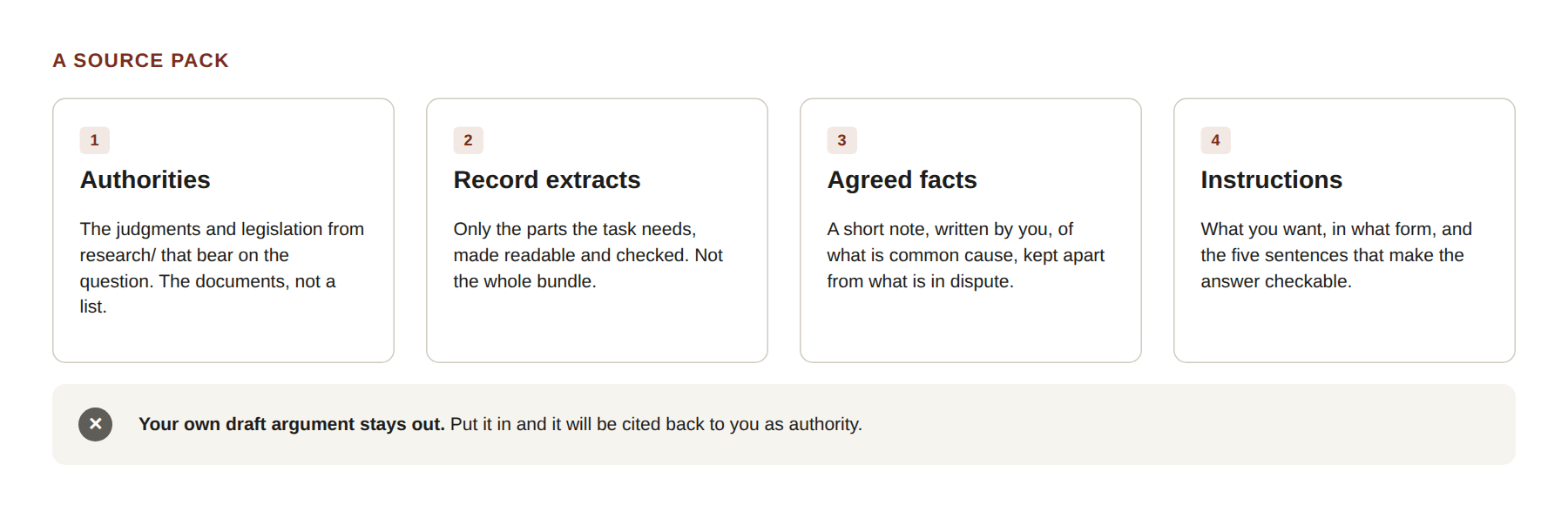
The authorities. The judgments and legislation from research/ that bear on the question. The documents, not a list.
The record. Only the parts the task needs, made readable (Guide 3) and checked. Not the whole bundle because it is there; more material is more to misread.
The agreed facts. A short note, written by you, of what is common cause, kept separate from what is in dispute.
The instructions. What you want, in what form, and the rules for the answer.
Keep your own draft argument out of the pack. Put it in and Claude will cite your draft back at you as authority.
Step 5 — The instructions that make the answer checkable
Five sentences. They do not make the answer right; they make it easy to check, because every claim comes with an address and every gap is labelled a gap.
Use only the documents I have listed. For every proposition, give the document name and the paragraph or page number. Quote only words that appear in the documents, in that order. If a point needs something that is not in the documents, say so and mark it as a gap; do not fill it from your general knowledge. Do not rely on any case that is not in research/.
Put them in the request every time, whatever the project instructions already say. The instructions set the standard; the repetition catches the moment.
Step 6 — Ask the question
A made-up example of a request that follows the rules:
Using only these documents — research/Mavundla [2025] ZAKZPHC 2.pdf, research/Northbound [2025] ZAGPJHC 661.pdf, and pleadings/Answering affidavit.pdf — answer this question: what did each court say about the responsibility of the practitioner who signs heads for the accuracy of the authorities in them? For every proposition give the document and paragraph. Quote only words that appear in the documents. If the documents do not answer part of the question, say so. Then list every paragraph you relied on. Save the answer as drafts/Latest Draft/Note on responsibility for authorities.md.
The answer will come back with paragraph references. Those references are what the next guide checks.
Step 7 — What the answer is, and is not
An answer from a source pack is a reading of the documents you supplied, with addresses. It is not a search of the law: a case you did not put in the pack is a case the answer does not know about. That is the point of the method, and also its limit. The question “what have I missed?” is still answered the old way, by you, in the databases and the textbooks.
Mistakes that are easy to make
Uploading the whole discovery bundle when the task needed three documents. Putting unread scans in the pack, so that the pack was smaller than it looked. Dropping your own draft in with the sources. And forgetting that a source pack is still an upload: the confidentiality questions in Guide 10 come first.
Check yourself
At the end of this guide research/ should hold every authority you may rely on as a PDF, with a line for each in _sources.md; every file should have been confirmed against its first page; and you should have one answered question from a source pack, with a document and paragraph for every proposition, ready for the checks in Guide 9.
Sources on file: LPC Code of Conduct, para 57.1. Parker v Forsyth NNO and Others (1585/20) [2023] ZAGPRD 1. Mavundla v MEC: Department of Co-Operative Government and Traditional Affairs KwaZulu-Natal [2025] ZAKZPHC 2; 2025 (3) SA 534 (KZP), para [54]. Northbound Processing (Pty) Ltd v South African Diamond and Precious Metals Regulator [2025] ZAGPJHC 661, paras [89] and [91].