Legal software used to follow rules. This lot reads.
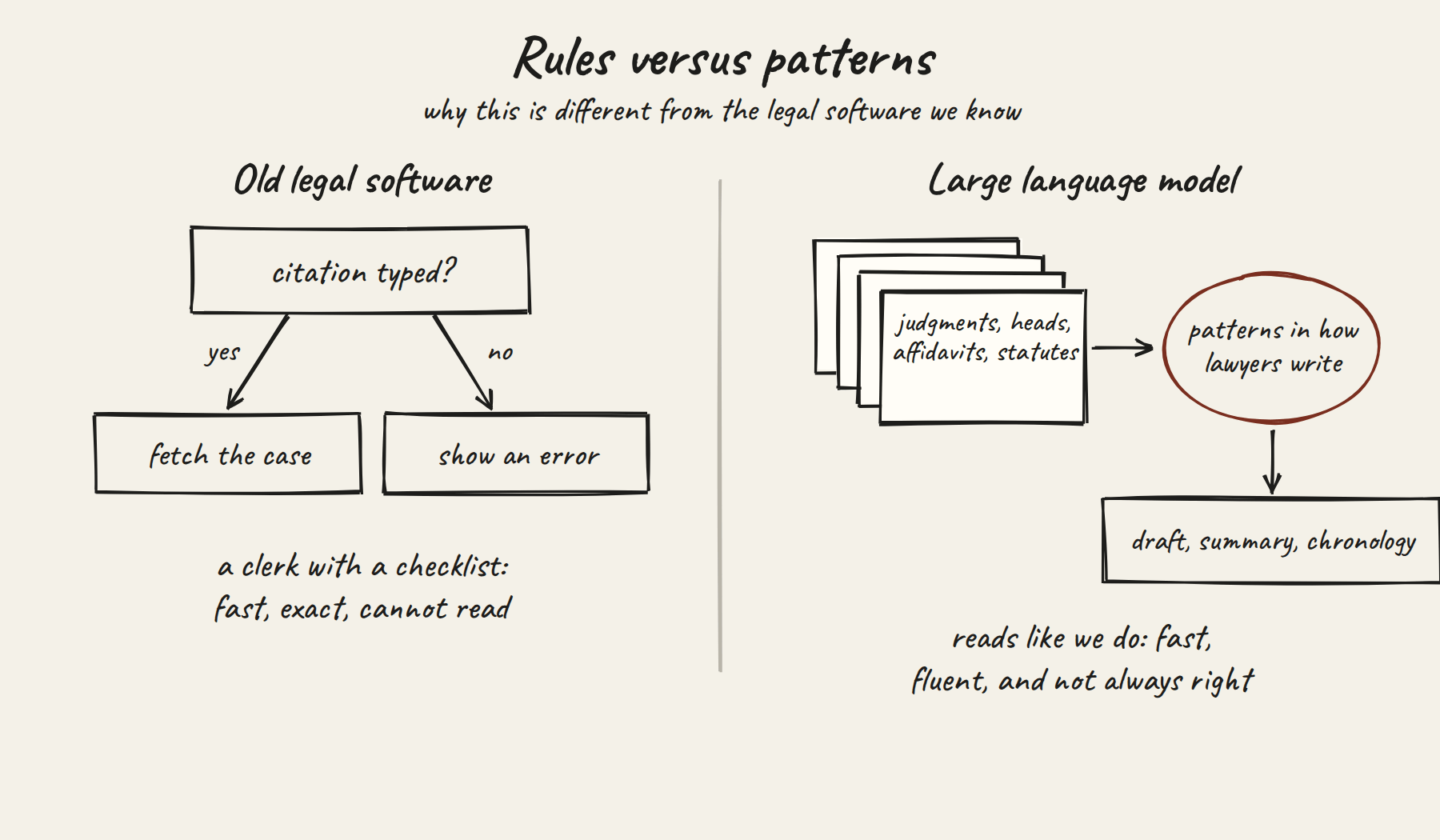
Most of the legal tech I have used in 25 years followed rules. Type a citation, get the case. Tick “contract”, get the contract fields. Useful, but it is a clerk. Fast, exact, and completely unable to read a record and tell you what is odd about it.
Large language models work differently. Nobody gives them rules. They learn patterns in language: how lawyers argue, how courts write, how statutes hang together. And that is most of what we do all day. Read a lot of words, work out which ones matter, write more words.
That is why the profession expects so much. Thomson Reuters’ 2025 survey of 2,275 professionals says those using AI expect to save about five hours a week, some 240 hours a year. Eighty per cent of them think AI will have a transformational or high impact on their work within five years.
My own experience is more modest. After months of daily use, the quality of my work has gone up. The time saved, so far, not so much. Occasionally I do something I simply could not have done before, like having hundreds of pages of trial transcript read and summarised.
And then there is the other side of the ledger. Damien Charlotin keeps a database of court decisions finding that someone filed AI-invented material. In the US alone it went from 11 such decisions in 2023 to 524 in 2025. Worldwide, it listed 1,624 cases by June 2026, and it grows almost daily.

So yes, it is a game changer. Both ways. It changes what one lawyer can do in a day, and it changes how badly one lawyer can get it wrong in a day. The scarce skill is no longer producing the words. It is checking them.
Sources: Lawyers Weekly on the Thomson Reuters Future of Professionals Report 2025 (a survey, so these are expectations, not measurements); Advocate Magazine on rules versus patterns; US yearly figures from the MSBA; worldwide count as reported by vaquill.ai. Check the live count at Charlotin’s database.